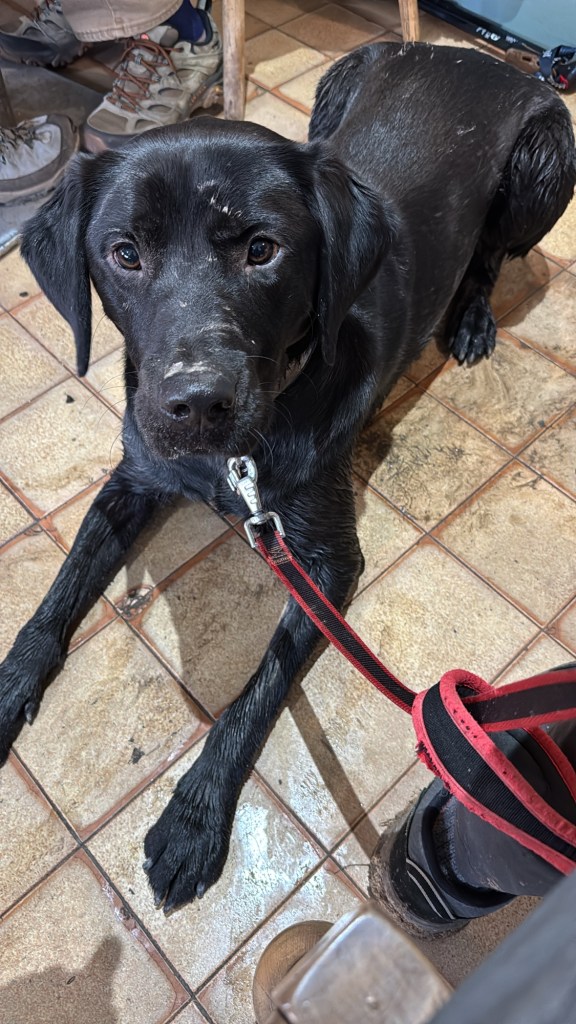
We visited Mum, although a care home isn’t the place to take a dog with the unpredictability of a small child, so he stayed in the car, and after the visits we’d have some well-earned playtime in a park nearby. Paths, trees and shrubs, frisbee and tennis ball, what more do you need? Lunch in cafes proved a great opportunity to meet like-minded dogs and their owners, and once again Jackson stole the show. Taking up space on the floor, of course, but drawing so much praise for how he conducted himself, and how well he’d trained me to pass him regular treats, fruit and veg with one hand while I fed myself with the other. Ambi-dog-strous you might say.
Staying on the Wirral peninsular gave us the chance to do some good long walks too, 10 miles along the coast on one day, just him and me, from cafe to cafe, woodland, field, beach and path. And despite feeling I should offer to mop the floor after lunch (he’d had his first experience of estuary mud just prior), he was made welcome everywhere we stopped for sustenance. Similarly a trip to the Shropshire hills to meet up with my other best friend, from Cheltenham, went smoothly with Jackson getting rave reviews in the restaurant where we had our Sunday roast.
‘Returning’ to the Wirral, where my parents grew up and later returned to in retirement, was a little strange for various reasons – not least that my Mum was no longer living in her own house, after necessarily taking up residence in a care home. But I had never lived there. We’d visited a lot, from the early years of our first labrador, through the boys’ childhood – eventful thanks to a few hospital visits – and up to my dad’s tragic and unexpected passing these had been largely enjoyable.
Then came visits to Mum as she tried to get used to life without Dad, and us staying in local hotels or AirBnBs to avoid any further hospital visits (allergies being the cause). So a few good memories but no particular anchor to the bungalow that meant more to my parents. The Wirral, however, was etched in my childhood memories – being by the sea or the Dee estuary was an experience of alphabetic proportions.
Most weekends until I left home we’d make the family pilgrimage to Birkenhead and the Wirral, calling on the eclectic family of great aunts and uncles with equally generous stories, smiles, hugs, servings, purses : Uncle Ben, reeking fondly of Virginia tobacco from his pipe, was always dispensing stories of the old days and pound notes or a 50p coin when we dropped by ; Auntie Cissy could have been a pro wrestler or chiropractor if she had put her herculean hugs to a different use ; Aunties Margaret and Dorothy, sisters and two real Liver Birds, could dispense tea and biscuits at a moment’s notice ; the list could go on.
So this part of Cheshire for me has always had a more general charm. As a student in Liverpool, I’d pop over the Mersey by ferry, or under it by train, to see the relatives – especially if there was a meal in it for me (Nan had been a school dinner lady, so always good for comfort food) in return. Earlier I’d sailed model boats with Dad on the boating ponds, swum in the Victorian pools, played in the parks and imagined adventures while playing in Grandad’s 3 storey house in Rock Ferry. All fair game for a 21st century nostalgia trip for a once-proud-northerner who simply became English when he crossed the border into Scotland.
One of the benefits of staying a bit longer somewhere is the chance to get to know the area a little better, to get lost, get in conversation with the locals and to get your feet wet. So staying for ten days meant there was ample opportunity to explore a little further. As it turns out, there’s more history and character to the area than I gave it credit for. Before being the market town it was to become, it was a Saxon town on the headland, this being the meaning of ‘nes’, and that very headland meant it was ideal as a port and anchorage for traders with Europe before Liverpool took on the role it was later famous for. Oliver Cromwell is said to have arrived at Parkgate by ship en route to Chester, and rather seasick it seems, during the English Civil War – something hard to imagine today when looking at the marshy margins that sit against what was once the red sandstone harbour wall and the old quay.
Walking the coastline, we discovered that there are in fact a series of ‘old quays’ along the estuary from Burton to Neston and Parkgate where the harbour moved as the Dee gradually silted up and became progressively harder to sail. There was also an enterprising mining venture in Neston for well over a century during the Industrial Revolution – the Neston collieries, taking coal from under the River Dee itself. Not a job for the faint-hearted, but it was still operational to some degree until the 1920s.
Parkgate, a village created at the gates to what was originally hunting parkland for the Neston gentry, is now something of a Mecca for birdwatchers, the marshland either home to or attracting a wide range of bird life – despite being adjacent to a Ministry of Defence firing range. And the marsh and fields are popular with dog walkers – plenty of new canine friends for Jackson, and a few of the equine variety either grazing nearby or riding along the abandoned railway line that’s now the Wirral Way, or the Charles III Coastal Path. And by staying around you realise how easy it is to pass the time of day with dog owners and walkers, something my dad spent hours doing in his time here. Cafe staff are always a source of local knowledge, too, along with bacon baps, cake, coffee … .


One thought on “Travels with Jackson – 1.3 On the Wirral, and the benefits of staying longer. January 2026”